Lakewood Informer

Resident generated news about Lakewood, Colorado

Lakewood Informer

Resident generated news about Lakewood, Colorado

Development

Zoning Fact Sheet Summary

Below is a one-page summary of zoning code changes and concerns from Lakewood residents. Lakewood Informer authors have posted multiple pages of content and more will be coming but this is a starting point to communicate with neighbors. Feel free to share and help people understand the issues. The fact that there is more to say than can fit on one page is a great indication that the changes are overly complex for a single vote by City Council. It’s very hard for residents to understand all the ways this will affect our neighborhoods, especially with no trials and everything changing at once. Much like the last zoning change which the city promised would solve problems and make things wonderful. In real life, the changes sparked backlash that last to this day. To this day, the city is not correcting those problems, just moving forward with bigger, denser growth. Other articles for more information: For a quick handout, the page below is available:

1031 S. Union Blvd. Subdivision

For those interested, the property at 1031 S. Union Blvd., next to the Green Mountain Swim Club, will have a public hearing for subdivision on Wednesday, July 16, 2025 @ 7:00PM. “Notice is hereby given that the Lakewood Planning Commission will conduct a Public Hearing at 7 p.m. on Wednesday, July 16, 2025  in the City of Lakewood Council Chambers, 480 S. Allison Parkway, to consider Preliminary Plat and Final Plat applications for a 12 residential lot Major Subdivision in the Small Lot Residential (R-1-6) zone district, submitted by Matt Hill and Matt Dendorfer of Compendium Developers for the property located at 1031 S. Union Blvd. The meeting will also be available to live-stream via Lakewoodspeaks.org. For information, please contact Kara Mueller, Project Manager at (303) 987-7982.” This lot is next to Green Mountain Elementary but does not involve the closed school. The single-family housing has been planned for about three years.

The Comprehensive Plan Bait and Switch

Comprehensive plans are easily readable documents that explain a vision for the future of the city in a moment of time. It speaks in plain English to what the zoning code describes in technical detail. The problem is that the zoning code details are what carry the force of law and because technical details are harder to read, it is easy for residents to overlook inconsistencies in proposed zoning compared to plans. This is otherwise known as a bait and switch. For instance, in the comprehensive plan, Lakewood promises to maintain neighborhood character; while in the zoning code, Lakewood implements high-density urbanization which resulted in the destruction of Belmar Park-adjacent property. Pieces of Lakewood’s Comprehensive Plan were used as evidence to fight against the Belmar Park development. Lakewood officials discounted all such arguments. Now that residents have caught on to the inconsistencies, Lakewood staff argues against using the Comprehensive Plan to guide zoning. Instead, Lakewood proposes changing the ordinance so that the zoning code is no longer tied to the comprehensive plan. With this change, residents could not form legal challenges based on compliance with the comprehensive plan and there is less room to fight against maximum buildout in adjacent properties. Do Residents Need a “Vision” Document Why have a comprehensive plan at all? This is a long-term plan that locks in the vision for this moment in time. It includes aspirational goals with no implementation details. Therefore, the details are filled in by staff using their discretion to interpret the zoning code. Technically, one government cannot bind future governments to its decisions. If tomorrow’s City Council wanted to change the vision of Lakewood, it could choose to do so. However, having a long-range plan laid down by yesterday’s Council is a roadblock that is not easily overcome. Residents would better understand the zoning code if each change had to be justified with open debate. Instead, as is currently occurring, the entire zoning code can be changed by saying the code matches the ambiguous goals of the comprehensive plan. For example, the as-yet unapproved Comprehensive Plan seeks affordable housing. Therefore, City Council reasons that ANY CHANGE to the zoning code will be acceptable as long as affordable housing is the intent, not necessarily the outcome. There is no need for an updated 100-page vision plan document to update 300 pages of zoning code. Why not just introduce one little change at a time that is easily understood by the residents, and easily tested for effectiveness? The proposed zoning changes are still being discussed and changed. City Council have taken months to understand these detailed changes. Residents will have a couple weeks. However, residents did spend months providing input into the comprehensive plan, that will no longer have much meaning. The Proposed Change Lakewood intends to remove the binding zoning code connection to the Comprehensive Plan. As first noted by savebelmarpark.com: Lakewood zoning code currently states that the Comprehensive Plan is the foundation for the Zoning Ordinance. However, the proposed redline removes the “consistency with the goals and policies of the Comprehensive Plan”. When the new zoning passes, all the aspirational goals laid out in the plan can be disregarded at will. Which really is no different than today, as shown by the Belmar Park debate except that today such a decision could be legally challenged and tomorrow it can’t. This specific change to the zoning code was not discussed at any public meeting. Comprehensive Plan Goals Not Followed The Comprehensive Plan states (pg 4-10): “Through the site plan review process and design guidelines, ensure that new multifamily, mixed use, and commercial developments adjacent to single-family neighborhoods are compatible by incorporating appropriate design, scale, height transition, and connectivity to seamlessly integrate with the neighborhood.” Residents compiled argument after argument to show that 777 S Yarrow St does not integrate with the neighborhood and does not meet environmental goals from the plan. Residents can clearly see that the Comprehensive Plan promises integration with the neighborhood. Residents can also clearly see that is not what staff implemented be allowing trees cut down to develop to the lot line near Belmar Park and new high-density apartments that don’t match the nearby buildings. . 15-minute Cities In other communities, residents are also waking up to this bait and switch. An opinion piece in the Boulder Daily Camera highlights this problem by examining Boulder’s 15-minute cities. This is particularly relevant since Lakewood leadership constantly mentions their desire for 15-minute city amenities. The proposed zoning code allows retail in residential zones for 15-minute planning.   Steve Pomerance, in the Boulder Daily Camera, addresses this issue: “The underlying problem with this whole conceptual framework is the self-contradictory assumption that we can have commercial centers in neighborhoods that provide an adequate variety of goods, services and transit, all within 15 minutes of where people live, but still keep our relatively low-density neighborhoods intact. This is simply not supported by the economics or the geography.” – Steve Pomerance Read the rest of that article to understand the same sense of contrasting values Lakewood is “selling” to residents. The new development at The Bend is promising 15-minute city amenities. “Selling” is the appropriate term used here because the zoning was contracted before the comprehensive plan was finalized. In another eerie coincidence with Boulder, Pomerance wrote, “It’s as if those who wrote these objectives had already decided that the results of the cost/benefit study would support implementing this concept, and thus support the massive densification required to create such neighborhoods. Community Input Into Zoning Up to this point, residents have had no input. It was not a resident-driven development.   Lakewood’s Chief of Sustainability and Community Development, Travis Parker, has been attending ward meetings to educate and also to promote the good points of the new zoning code — as if there are no other options. No one has addressed the dissatisfaction with the current densification in Lakewood. Does a desire for affordable housing mean automatic agreement to sacrifice current neighborhoods? More

Save the Land at the Old Lutheran Hospital

Wheat Ridge is facing the same pressures as Lakewood. Both cities want to turn established neighborhoods and properties into something completely different with little public input. Does any of this sound like the Belmar Park problem to you? High-density, no setback, no parking… a big change that the city has to make big changes for while not listening to big public pushback. Update: A quick count of the days shows that Wheat Ridge is giving residents 9 days to petition instead of 10 because July 4 is a holiday. There’s always another challenge. Let your Wheat Ridge friends know to get over to sign soon! From Stop Zoning of High Density Housing in old Lutheran Hospital Save the land at the Old Lutheran Hospital from becoming a high-density housing project! 1,200 Signatures needed. Wheat Ridge residents: Meet at The Historic Blue House @ Old Lutheran Hospital to sign June 24-July 3 , 7am-7pm What’s up with the new zoning of the old Lutheran campus?Here’s what people are saying: A change of this magnitude should be voted on by all citizens of Wheat Ridge. Allows the creation of a crowded urban environment on much of the property: More than 2,000 housing units can be built, according to the developer. [Sec. 26-1404]Maximal building coverage. [Sec. 26-211, 26-1405] No setbacks. [Sec 26-1405] Minimal landscaping and open space [Sec. 26-1405; 26-1409, 26-502]. No parkland dedication to the City is required. [Sec. 26-414] Minimal parking [Sec. 26-1407, wheatridgespeaks.org/items/1522] Variances from even these minimal standards are allowed, including variances of morethan 50%. [Sec 26-1416] No Historic Designation or Registry of the Blue House, Chapel or Tuberculosis Tent. Nothing about affordable homeownership. [It’s not found anywhere in MU-LLC regs.] No limit on the number of units that can be rentals. [It’s not in the MU-LLC regulations.] NO traffic studies have been done. Read more about this issue on their facebook page And find time to sign their petition at one of the meeting times: at The Historic Blue House @ Old Lutheran Hospital to sign June 24-july 3 , 7am-7pm

Why should habitats including Belmar Park be protected?

From SaveBelmarPark.com Because “biological annihilation” is happening NOW according to Stanford biologists Paul Ehrlich, Rodolfo Dirzo and colleague Gerardo Ceballos.  Key quotes from the paper: “Earth’s sixth mass extinction episode has proceeded further than most assume.” What is Lakewood City Council doing locally to help the planet deal with this crisis? Lakewood’s answer is to ignore science and promote luxury housing that will harm a riparian habitat while citing the fake ‘housing shortage’. Yet the city council wants everyone to think there is not enough housing for a ‘growing’ population.  City council, when does your denial of reality cross the line from being misinformed to being blatantly dishonest? The county has lost 4% of population in 4 years.  The local school district has closed 21 schools since 2021.  School buildings are actually up for sale in Lakewood.   Lakewood’s housing pipeline already has a 10-15 year supply based on the city’s own study!  Zillow shows over 1,500 rentals advertised in Lakewood today including hundreds of units within walking distance of Belmar Park. Council members, if this summation is not correct, then please explain why you refuse to protect habitats including Belmar Park.  Eminent domain is at your service if needed. Yes, the Kairoi Belmar housing project, as planned without a science-based raptor buffer zone, will harm the rare riparian wildlife habitat at Belmar Park. Lakewood City Council cannot fix a global problem.  But they can show leadership and be a model for how cities can play an important role. City Council, please do not take comfort just because you are not alone in participating in the sixth mass extinction event and stealing from the future of our children. Lakewood, this is exactly how to give the children a planet struggling to support human life.  Or worse. Colorado Parks and Wildlife recommends a raptor buffer zone at Belmar park based on ‘best available science’!   Is that too much to ask? Some might say why worry?  There is plenty of wildlife in Africa, so let’s eat, drink and be merry and forget about protecting habitats here.  The planet is too big for humans to ever ruin it. Unfortunately, Dr. Lawrence Frank is quoted above regarding the ‘horrific’ loss of wildlife in Africa over the last 200 years. He spent decades tracking and studying lions in Africa.  He started back before GPS tracking collars for lions were even available.   Back then, once you had a collar on a lion, you had to drive around off road in Kenya to try and get in radio range of the collars using a YAG antenna to track and count the animals.  He told me bouncing around on that terrain was very hard on his back.   He explains during the Q&A at the end of the video that as humans continue to encroach on habitats in Africa, what wildlife still remains has a very uncertain future. Dr. Ehrlich’s paper points out that species extinctions over the last 200 years should have taken 10,000 years! What is happening is a global crisis.  Protecting habitats will be the best and probably the only way out of it. Some might cite the recent example of the dire wolf that was supposedly extinct but brought back to life via genetic engineering by a company called Colossal Biosciences.  The hope the company was claiming is that other species could be resurrected from extinction using the same technology.   But the company’s chief scientist has now admitted just a few weeks ago the animal was not a true dire wolf but simply a grey wolf with a few modified traits to make it resemble the appearance of a dire wolf. Humans make up less than 0.5% of the total biomass of the planet, yet we are responsible for the ongoing 6th extinction event.   Wild mammals make up even less of the total biomass than we do! It is up to us stop it.   The Ehrlich paper explains that ecosystem services essential to civilization are already being eroded and damaged. There are 20 to 30 years at most to stop the mass extinction event. It is time to wake up.  That includes you, City Council.  Wake up.   You are responsible for protecting habitats in Lakewood.  Please do your job for the sake of your own children. Thanks for listening, Steve

Zoned Out: How Lakewood is Selling Out its Neighborhoods

By Karen Gordey You’d be forgiven if you missed it — after all, the City didn’t exactly roll out the red carpet for public input — but Lakewood is in the middle of completely rewriting its zoning code. And on May 21st, the Planning Commission passed 16 amendments in one night. Sixteen. Because who doesn’t want to restructure the entire city with the speed and clarity of a late-night city hall cram session? Here’s the kicker: Lakewood is a home rule city, meaning we have the power to make our own land use decisions. But instead of using that power to protect neighborhoods or push back on one-size-fits-all state mandates, the City Council passed a resolution last year (Resolution 2024-62) that basically says, “Tell us what you want, Colorado — we’ll make it happen.” Meanwhile, six other cities are suing the state to protect their local control. Lakewood? We’re sending engraved invitations to the bulldozers. If you’re not paying attention yet, you should be. Because staff expects these changes to take effect in September and if residents don’t start showing up and speaking up, we’ll be stuck with zoning we didn’t ask for, can’t undo, and won’t recognize. “Home Rule vs Statutory Rule” Before we go any further, it is important to understand the difference between statutory rule and home rule.  So that there is no confusion, I went to the Colorado Municipal League’s website (www.cml.org).  The following is their explanation of the two:  “Colorado cities and towns operate under provisions of Colorado state statutes (and are referred to as “statutory” cities and towns) unless voters adopt a municipal charter to become a “home rule” city or town. Home rule is based on the theory that the citizens of a municipality should have the right to decide how their local government is to be organized and how their local problems should be solved. Municipal home rule derives its authority directly from the Colorado Constitution. It affords residents of cities and towns that adopt a local charter freedom from the need for state-enabling legislation and protection from state interference in “both local and municipal matters.”  The Lakewood City Charter was established on November 1, 1983.  While it has been modified by the voters 5 times (the latest on November 2, 2004, we are still a home rule city.  Lakewood City Charter and Lakewood Together Page 27 of the City Charter talks about planning and zoning.  According to the charter, the city council could have established Ward Advisory Committees to try to corral all these changes but instead are using Lakewood Together for community input.  In fact, I attended the Ward 5 meeting on June 14th and Councilman LaBure said that he tried to create committees last year and did not have support for this.  Let’s take a look at the Lakewood Together site.  On the front page of the zoning updates section (Lakewood Together Zoning Updates), it clearly references the state law requirements and again we are a home rule city so we are allowed to do what is best for our community. This will be important to remember when I talk about the 16 amendments. The 2024 City Council Resolution: Pre-Commitment to State Zoning Goals The City Council passed a resolution Resolution 2024-62 that sounds harmless — values like affordability, walkability, and sustainability — but when you read the details, it’s a blueprint for surrendering home rule. The resolution adopts state-level zoning goals before zoning code revisions or public feedback were complete. That includes: Bottom line: Lakewood didn’t just “revise” its zoning goals; it absorbed the state’s playbook wholesale.  This was covered briefly by the Lakewood Informer: Jedi Mind Tricks – The New Zoning Code WILL BE Good Why Didn’t Lakewood Join the Lawsuit with Other Home Rule Cities?  Good question! Recently, six Colorado cities banded together to sue the state over its new zoning mandates — arguing that the laws violate their constitutional rights as home rule municipalities. (6 Front Range cities sue over housing laws, governor’s threat to withhold state funds) Lakewood? We sat that one out. At the Ward 5 meeting on Saturday, June 14th, I asked our Councilors a simple question: Was our absence because of Resolution 2024-62, which essentially pre-commits Lakewood to implementing state zoning goals? And if the lawsuit is successful, meaning those cities win back their rights to local control, won’t we be stuck with sweeping zoning changes we didn’t have to make? Councilman LaBure responded: “We are a home ruled city but we are also a state entity. The state passes things all the time that encroach on local control. The argument has been historically well zoning and parking issues and all those things are matters of local concern and not the state concern. And Judiciary had tended to draw a line there. However, the state has increasingly been making the argument that there is a housing crisis statewide so we need more and more control over local zoning issues because it is actually a matter of state concern. I would have been happy to have jumped on that lawsuit however, other cities already did it and we are part of the Colorado Municipal League (CML). And CML has supported that lawsuit and in that sense we are member and if not the largest so in some sense we are part of that because of our CML affiliation. And it is a fair question to ask about if the lawsuit is successful, then we would be stuck with zoning changes that were not needed.” Translation: we could have stood up for home rule; but we’ll just let other cities take the heat and hope our dues to the Colorado Municipal League somehow cover us by association. Councilor Nystrom added that she did ask the City Attorney the same question but didn’t get a clear answer. She also pointed out that HOAs aren’t safe from this zoning overhaul either. While HOA covenants are seen as contracts between homeowners and their associations, local

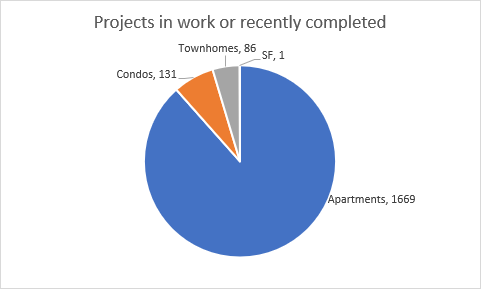
Disproportionate Development of MultiFamily

A new analysis shows an overwhelmingly disproportionate amount of new apartment buildings. A Lakewood resident developed the pie chart above by researching Lakewood’s current project list. This is something that has been obvious to resident for awhile but it helps to see the graphic and we at Lakewood Informer appreciate the insight. Thank you. Statistically, 95% of current projects are for high-density, multi-family units. 88% are for apartments and 7% are for condos. Low-density, multi-family townhomes account for 5%. Continuing this projection, this many new multi-family units will quickly change the voting patterns and priorities of Lakewood residents. Lakewood management hopes to accelerate this trend of thousands of new units through the new zoning code that will substantially change neighborhoods. The narrative of “affordable housing” is clashing with the desire to maintain Lakewood’s natural character. This has caused some residents to question the need for government interference in the housing market. This also shows the lack of balance in bringing new jobs to the area with no commercial economic development.

20,000 New Apartments Lowers Rent by (only) $56

From savebelmarpark.com Many of you are aware of the ongoing attack on Front Range habitats including Belmar Park, Chatfield State Park and Bear Creek Lake Park.  Unfortunately, habitats are under pressure globally which threatens the web of life for everyone on the planet. This trend is often justified locally by proclaiming the need to ignore the value of habitats because there is a ‘housing shortage’ and building more housing is necessary above all else. While statistics are not supportive of that argument for the Lakewood area, proponents continue to repeat it for lack of anything better to spout. Some even claim that regardless of whether there is an actual shortage of housing, it is necessary to build more housing in order to reduce the cost of rent.  In other words, if there are enough vacant, unused rental units, THAT will cause rent to come down significantly. Yet that 20,000 units was actually a much larger than average inventory increase. “This growth far exceeds Denver’s average annual construction of 11,400 units over the past five years” according to JP Morgan.  Because adding 20,000 units was such an outsized increase, it should have reduced rents significantly but for many local residents the $56 was not enough relief.   Yes, rents declined but according to the FOX31 report, developers also reduced apartments under construction by over 36% which will exert upward pressure on rents. Proponents of continuously building more and more rental units might say the minimal rent reduction was due to the upward pressure on rents caused by the population increase!   They claim we need to keep building rental units to accommodate the population increase in Lakewood which is causing the so-called ‘housing shortage’. What population increase are they talking about?   Developers don’t seem to agree with the growth argument since they reduced the amount of units under construction by 36%. The US Census Bureau shows Lakewood has experienced a population increase of less than 1,000 people from April 1, 2020 through July 1, 2024.  That is almost zero growth over 4 years! Even Denver has increased only 13,500 which is less than 2% total growth in that extended 4-year time period.  Compare that to the 20,000 units added plus the 11,000 units per year average for earlier years.  It would seem a lot more units are getting built than are needed. Jefferson County has actually lost 4,000 population in that same time period. Neither Lakewood nor Jeffco are in a population growth mode. As you probably know, because the secret is finally out – Jefferson County is closing schools!  Even selling off school buildings. That is not exactly an indication of population growth.  Just the opposite. So let me ask, if I can find this data and you can click and easily verify it, why can’t the Planning Commission or the City Council find these relevant facts to inform their planning horizon and policies?  What is that different drum they are dancing to? Why do we have to sacrifice the habitat quality of Belmar Park to accommodate population growth that does not exist? And as far as the use-by-right argument for private property?  We have previously exposed the fact use-by-right is irrelevant since the developer has to do earth moving in Belmar Park itself and they needed Lakewood to surrender valuable easements to enable their project.   Instead of use-by-right, we should call it use-by-deception. So the question still stands.  What is that different drum? For more info, click here.

Lakewood is Laughing At Us

The May 7th Planning Commission meeting was a travesty of a public hearing. Lakewood cared enough to give residents an outlet for their grievances. No one cared enough to enact a single change. And sometimes they outright laughed at us. Watch the video below from the end of public comment, starting at min 2:58:25. One resident got up and publicly read an article from the Lakewood Informer. Watch the city staffer seated in the background unsuccessfully hiding her laughter during this reading. All of which was proved to be true. All of which city staff ignored and the entire Planning Commission dismissed — just like so many other valid resident points. The meeting started with Lakewood Chief of Sustainability and Community Developer Travis Parker explaining that he didn’t think this meeting wouldn’t change anything. He said that there were “pretty significant misunderstandings” of what staff could do. He said that “attacks on staff for being, you know, incompetent or malfeasant or acting in bad faith, demonstrate a fundamental misunderstanding of the good and hard work that’s done by people that are experts.” No one doubts city staff work hard. They all deserve thanks. But we also can’t assume they are always right and the residents are wrong about everything. We can’t assume that there is no other way to evaluate base assumptions. But that’s exactly what the Planning Commission decided to do. Ironically, one of the main points of the Belmar Park battle was about cutting down all the trees that could have formed an expanded buffer. Mr Parker himself has been educating residents on new zoning codes from Lakewood that will not increase the setbacks to what they were pre-2012, but will now require RESIDENTS to get a permit to cut down their trees. So the meeting was a pretty show that started and ended with all the well-researched points the residents brought forward being dismissed. Sadly, the best thing to be said is that being dismissed was more respectful than being laughed at. Required Grading Permit – Evidence not reported by city staff The permit pictured above is from Lakewood’s eTRAKit system, showing the grading permit that was applied for and received within one day of the complaint, just as reported by Steve at savebelmarpark.com The permit below is for demolition, which was applied for a month earlier. No malicious intent was implied and the problem was quickly corrected. Thanks to residents who apparently know less than city staff. Grading permit requirements below Actual permit that must be displayed before construction:

UPDATE: Disappointing but Not Surprising – We Need Your Help Now More Than Ever!

From Save Belmar Park, Inc., – a Colorado non-profit What happened at the May 7th Lakewood Planning Commission hearing was deeply disappointing—though sadly, not unexpected. After several speakers delivered well-researched, thoughtful, and heartfelt presentations, the audience erupted in applause. The public’s support for protecting Belmar Park was undeniable. So how does a small group of City officials override the will of the residents? Despite an overwhelming outpouring of public opposition—including emails, social media comments, and a nearly 10-to-1 ratio of anti-this-development comments on Lakewood Speaks—the Commission still voted 5–0 in favor of the 411-unit Kairoi apartment building. And they did so even after being presented with a powerful, evidence-based case showing that the proposed development directly contradicts Lakewood’s own zoning code, comprehensive plan, and parks master plan. This vote was a slap in the face to the community. It disregarded common sense, environmental preservation, and the very planning documents the city is supposed to uphold. The proposed zero-lot-line, six-story building is incompatible with the surrounding two-story Belmar Commons townhomes, overwhelms local infrastructure, and threatens the ecological balance of Belmar Park. The city has rolled out the red carpet for billionaire developers—again—ignoring the public and prioritizing profit over people, parks, and trees. Dozens of mature, century-old trees will be clearcut. Wildlife will be displaced. Belmar Park’s peace and beauty will be irreversibly damaged (if we don’t stop them). But, we have NOT given up—and we’re not stopping now! Our next step is filing a lawsuit under a 106A appeal, which will go before a Jefferson County district court rather than more city insiders. We believe we still have a strong chance at a different outcome—despite the city’s push to bulldoze trees—because the proposed development blatantly contradicts Lakewood’s own zoning laws, comprehensive plan, and parks master plan, giving us solid legal ground to challenge it in court. This is our last real chance to stop this destructive project, and we’re counting on supporters like you to help us make it happen. Legal fees are significant, and this is a fight the community should not have to fund—but we must because the City of Lakewood refuses to listen. Please stand with us—again. If this park means something to you, dig deep—and give as generously as possible (then smile knowing you’re helping to save something irreplaceable). Every dollar helps us hold the line against this destructive plan. Then share our campaign and spread the word. We’re fighting for what’s right: environmental integrity, community character, and the future of Belmar Park. 👉 Donate now: https://www.gofundme.com/f/save-belmar-park Directors Save Belmar Park, Inc. 

Scroll to top